
Balquhidder (Gaelic: Both Chuidir) meaning ‘village with fodder’.
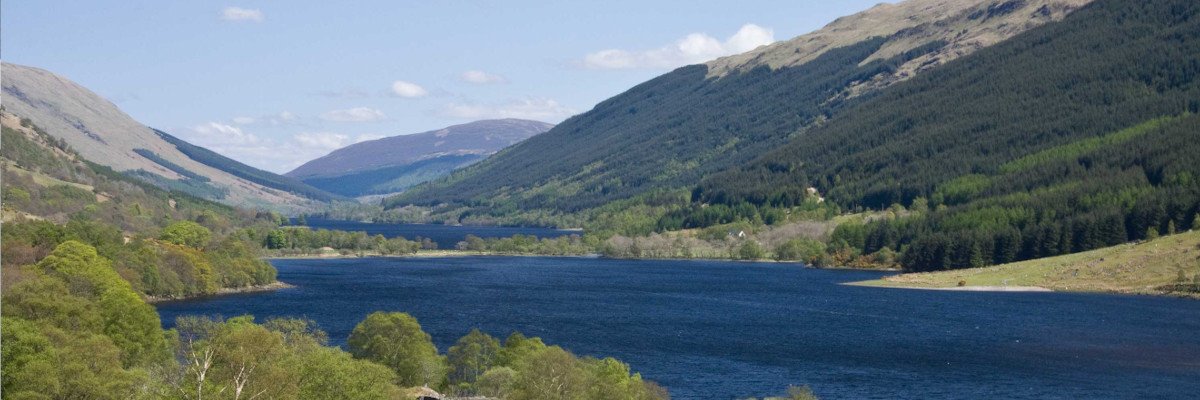
Lying beneath the beautiful Braes of Balquhidder at the head of Loch Voil, the small hamlet of Balquhidder nestles amidst breathtaking scenery. The beautiful village shares its name with the glen in which it stands, Balquhidder Glen, which extends westwards for 12 miles from the A84. The glen is a true cul-de-sac, with its western end concluding in the complex mountainous country north of Loch Katrine and south of Ben More.
Balquhidder is probably most famous for being the final resting place of the rebel outlaw Rob Roy MacGregor. Rob Roy MacGregor, the second son of Donald MacGregor, was born in the mid 1650’s at Inverlochaig at the head of Loch Doine.
His life as an outlaw started when he was unable to repay money that he had borrowed from the Duke of Montrose to fund his growing cattle trade. The Duke seized his lands and property and Rob Roy fled with his debt unpaid.
From this time onwards Rob Roy and the followers he had gathered (at one point Rob Roy had a following of 500 men), profited from raiding lands of the Duke and those of his neighbours. Though he relieved many of their property it is said that he was never brutal or cruel with his victims and never stole from the common man, there was after all no profit from robbing a poor man.
His success allowed him to send each year a cow and a fat sheep to the minister of Balquhidder who in turn made no inquiries about the source of his wealth. It was during this time that the Duke of Montrose captured Rob Roy. However, he made a famous escape, with the aid of a friend in the employ of the Duke at the ford in the river near Balquidder. Rob Roy died in his home in 1734 and was buried in the small churchyard in Balquhidder.
Balqhidder’s Victorian church and the ruins of an earlier church dating from 1631, but standing on 12th century foundations contains a number of interesting memorials of the McLaren family, who were the hereditary clan of Balquhidder since the 9th century, and who suffered brutally at the hands of the MacGregors. Rob Roy visited the old church occasionally, and the church bell was stolen by Rob Roy at one point. Outside the ruins stands Rob Roy’s grave, buried next to his wife Mary and his two sons.
This whole area was once well farmed, reflecting its position on a major hill route. To the south of the glen is Glen Finglas, now its lower valley flooded to provide a water reservoir. Glen Finglas served as the background to Sir Walter Scott’s romance The Lady of the Lake a poem that brought the first influx of tourists to the Trossachs. It was also in Glen Finglas that a band of MacGregors clashed violently with the Colquhouns in the key dispute that produced the fugitive life of Rob Roy MacGregor and his clan.
Balquhidder Glen extends to the west for approx. 11 miles from the main A84 just south of Lochearnhead. The village is particularly popular with walkers and those interested in nature with an abundance of beautiful flora and fauna as well as red squirrels, deer, otters, osprey and wild orchids. The local scenery has been used as a backdrop for a number of films makers in the past, featuring in ‘Geordie’, ‘The Thirty Nine Steps’ and more recently ‘Four Weddings and a Funeral’.
Balquhidder has the following facilities
Explore Balquhidder
Use the search feature below to explore accommodations, activities, attractions, and places to eat and drink, in and around Balquhidder.